Colin Sheridan: The Lions as a modern concept is utterly idiotic

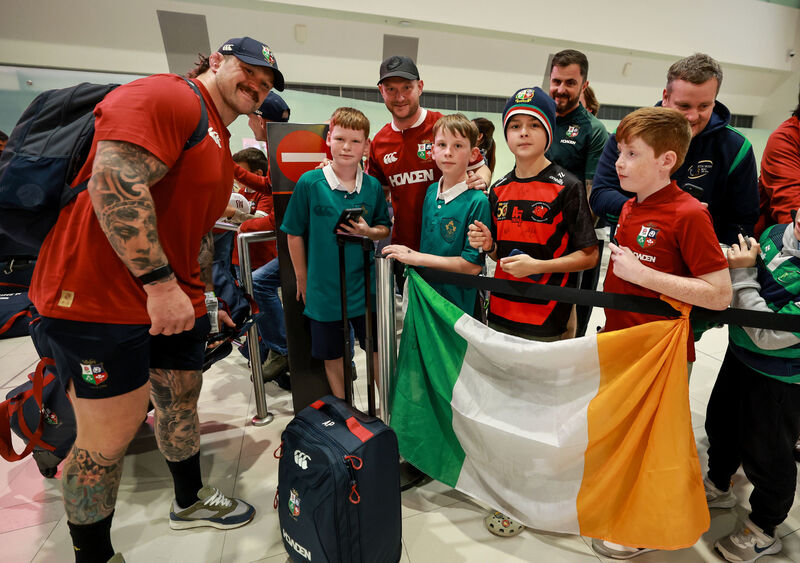
G'DAY: Lions players pose with an Australian mascot. Pic: ©INPHO/Dan Sheridan.

If the British and Irish Lions tour didn't exist, would we invent it?
Let us, for a moment, imagine a committee of highly-paid rugby executives – all pale of face and plummy of accent – gathered around a mahogany table in Twickenham, plotting their next great adventure.
One lifts a finger and announces, "What if we sent 38 large men, with a support team of 200, to the other side of the world for eight weeks to batter each other into oblivion… for tradition?"
Cue enthusiastic nods. And thus, the 2025 British and Irish Lions tour to Australia is born – again.
Another quadrennial ritual of flying furniture, pub invasions, and the vague hope that the lads can make it through customs with both kidneys and a functioning hamstring.

But here’s the truth, whispered gently through a Guinness moustache: the Lions tour, as a modern concept, is utterly idiotic.
It’s not that we don’t love the idea of four nations coming together under a single banner. It’s very Eurovision. But if ever there were a tour that feels like a stubborn hangover from the Empire, this is it.
It's a sort of rugger colonial cosplay, where Irish lads pretend they’re grand with sharing a jersey with Englishmen, provided no one brings up the Troubles or the 2003 World Cup.
Every four years, they ask us to forget 800 years of mutual resentment, wrap ourselves in a weird hybrid jersey that looks like a schoolboy’s mashup of nation flags and try to cheer for someone from Surrey. You might as well ask Cork to support Kilkenny in the hurling final because "they’re Celtic too".
To Australia, then. The land of giant insects, casual racism. The Wallabies haven’t been good since George Gregan had knees, and their domestic game is so bankrupt of quality, their top fly-half is currently playing part-time in France and full-time on Instagram.
And yet we send a team of highly trained, heavily sponsored battering rams halfway across the planet, to play in half-empty stadiums where the local fans are too busy watching Aussie Rules or fighting with a lamppost.
It’s like flying to Las Vegas to play chess with a toddler who’s more interested in chewing the rook.
Once upon a time, the Lions tour was about grit. It was about sleeping on floors, midweek games against farmers, and eating whatever the chef could boil in one pot. Now it’s more choreographed than Beyoncé’s halftime show.
Each player seems to get their own physiotherapist, nutritionist, video analyst and social media manager. There are drone cameras for lineout practice. The gym equipment costs more than a school. And all of it is sponsored by more corporations than an F1 driver’s helmet.
It’s tradition, they say. But tradition doesn’t usually come with a LinkedIn page and a licensing deal. This tour has more branding than a Donegal cow.
Let’s be honest – the rugby’s not even that good. Half the players are wrecked after a full season of URC, Premiership, Top14 and Champions Cup. The other half are either 12 years old or held together with tape, adrenaline and blind hope.
The midweek matches are glorified training sessions against teams with names like “ACT Jackaroos XV” or “Western Suburbs Invitational Baa Baa C Team”, where the opposition pack is mostly plumbers and the out-half once played tag rugby with Quade Cooper’s cousin.
And then come the Tests. Three matches of nuclear violence dressed as sport. By the second Test, there’ll be four red cards, three failed HIA assessments, and one winger stuck upside-down in the turf.
You spend €7,000 to fly over, sit in a stadium that smells like sunscreen and regret, only to watch two tired teams batter each other in slow motion until the TMO finally decides someone blinked the wrong way and awards a try.
Then there are the fans – oh, the fans. Thousands of men, who could've played for Ireland had they not done their knee in on their brother's stag in Budapest, pack themselves into novelty suits and stagger from Brisbane to Melbourne to Sydney in a haze of beer, sunburn and misplaced optimism.
Every pub they touch turns into a temporary embassy for craic, karaoke, and deeply inappropriate renditions of “Swing Low, Sweet Chariot”.
Somewhere between the fifth pint and the tenth chorus of "The Fields of Athenry", they forget the score, the venue, and occasionally, their own name.
Some will not return with their dignity. Some will not return at all. But all of them will agree it was "grand craic" – even if they can't remember if the Lions actually won.
Imagine, just for fun, if instead of this testosterone-fuelled tour de farce, we simply had the Lions host the Wallabies in Dublin, Cardiff and Edinburgh.
Give the Aussies a chance to experience 6°C rain in June and what it's like to get a ham sandwich thrown at you in Temple Bar.
But no – instead we send our boys on a brutal long-haul meat grinder for the sake of "legacy". A legacy that involves half the squad needing rotator cuff surgery before pre-season.
And let’s not even start on the politics. You think picking an Irish captain will stop English journos from whinging? Or that leaving out Owen Farrell won’t result in six columns in the titled “Where’s Our Saint George?”
We’re told the Lions is about unity. But between squad selection outrage, inter-nation bickering, and at least one coach muttering darkly about player quotas, it's more Balkan than British.
So yes, let us once again gather our collective rugbying delusions, pour them into an overpriced jersey, stick them on a Qantas flight, and pretend that this Lions tour is the very heart of rugby tradition.
But know this: deep down, beneath the chants, the hype videos, and the sound of Hamish Watson being dropped again, there’s a little voice saying:
"This is daft."
And that little voice has a point. Because sometimes the emperor has no clothes. And sometimes the lion is just a very tired dog in a wig.
There are nights when the script is torn, crumpled, and launched into the wind. Saturday in Limerick was one such evening. What was meant to be a routine march for the four-in-a-row All-Ireland champions became a cinematic twist, directed by a group of Dubs who didn’t read the part about inferiority.
Dublin hurlers — more often flat notes in the Munster symphony — produced a performance of such grit and guile that it stunned a city accustomed to dominance. Limerick, those towering sons of green who have laid waste to all challengers in recent summers, looked mortal. Dublin made them look ordinary.
There was nothing flukish about it. This wasn’t backs-to-the-wall, hang-on-and-hope hurling. It was fierce, fluid, and full of fight. Dublin’s collective chaos rattled Limerick’s once-impervious rhythm. They harried, hunted, and hit with a venom rarely associated with the capital's hurling heart.
And when the final whistle blew, the scoreboard didn’t flatter: Dublin 1-25, Limerick 0-27. Not a typo. Not a dream. A statement.
John Kiely looked as if he’d just walked into a room where the furniture had been rearranged. Familiar foundations had cracked. The champions, still undoubtedly the team of the decade, found themselves out-thought and out-fought by a side few had on their radar.
In Dublin hurling folklore, this result will ring loud. Not just for what it means for this year's championship — but for what it says about belief, resilience, and the madness that makes sport the finest theatre we have.
The Dubs came to hurl. And they rewrote the ending.
Last night's NBA finals decider between the Indiana Pacers and the Oklahoma City Thunder was the first series to go seven games since 2016. While both teams are much beloved by their home fans, neither are what the league consider “big market” franchises.
The viewing figures may have suffered as a result which is a shame because, in OKCs Shai Gilgeous Alexander and Indiana's Tyrese Haliburton, the league has a pair of stars that could light up the game for next decade.
Oklahoma and Indianapolis may not boast the glitz and glamour of Los Angeles and New York. In this epic series, they proved to be much greater for it.
Damien Duff's shock departure from Shelbourne on Sunday is another chapter in the most compelling story in domestic Irish football.
At the time of writing, the exact reasons for his exit are unknown, but what is certain is he will tell us. You would hope, too, that he will not stay gone for long. Regardless of one's opinion of the former Chelsea man, he's been the best thing to happen to the League of Ireland in decades.
The league needs him. Whether or not he needs the league is something he'll be sure to tell us.